

Key Takeaways
Planning a move in Toronto or the GTA? The type of relocation you’re undertaking changes everything — timelines, equipment requirements, cost structures, and regulatory obligations included.
- Residential moving centres on household belongings, flexible scheduling, and white-glove personal care — priced by crew size and hours
- Commercial moving is driven by business continuity, specialized equipment, and regulatory compliance — quoted on full project scope
- Planning timelines differ significantly: residential moves can be coordinated in 2–8 weeks; commercial relocations routinely require 3–6 months of phased planning
- Equipment needs are different: household moves use standard dollies, blankets, and wrapping; commercial relocations may require air bearings, certified IT packing, server crating, and modular workstation disassembly
- Costs scale differently: residential quotes are linear (crew × hours); commercial quotes factor in after-hours labour, lift equipment, and the full operational footprint of the business
- Insurance requirements are higher for commercial moves — businesses typically need coverage equivalent to 3–5% of total asset value, far above the standard residential rate of ~$0.60/lb
- Moving GPT handles both with 10+ years of experience across Toronto, Etobicoke, North York, Scarborough, Mississauga, and the GTA — backed by insurance coverage up to $5,000,000
Two moves. Two completely different operations.
You might assume a move is a move — pack, load, go. But the planning, logistics, costs, and risks between a residential and a commercial relocation are so different that treating them the same is one of the most common and costly mistakes people and businesses make.
Most residential moves in Toronto take one or two days. A commercial office relocation for a mid-size business can take weeks of phased execution — and months of advance planning before a single box gets touched.
Here’s what separates the two, what each genuinely costs in the GTA in 2026, and exactly how to prepare — whether you’re relocating your family home or your entire business operation.
What Sets Residential Moving Apart
A residential move means one thing at its core: relocating the contents of a home from one address to another.
“Simple” doesn’t mean effortless, though.
The Scope of a Home Move
Every home is different. A one-bedroom condo in Yorkville and a four-bedroom house in Etobicoke are both “residential” moves — but they sit worlds apart in crew size, time, and complexity.
Typical residential moves involve:
- Furniture, appliances, and electronics
- High-value or fragile items: artwork, pianos, antiques, designer pieces
- Personal belongings requiring careful, discreet handling
- Disassembly and reassembly of beds, shelving units, and modular furniture
At Moving GPT, every item — from a single box to a concert grand piano — is handled with the same white-glove precision.
Flexible Timelines — and Why They Matter
One of the key advantages of a residential move: scheduling flexibility.
Most Toronto homeowners coordinate moves around lease expiry dates, school calendars, or personal timelines. With the right planning window — ideally 4–8 weeks — transitions can be timed for minimal disruption.
Key scheduling realities for GTA residential moves:
- Weekend and end-of-month slots book fastest — reserve early, especially May through September
- Condo elevator reservations typically require 48–72 hours’ notice minimum from building management
- Same-day and last-minute moves are available through Moving GPT — built for when life doesn’t follow a calendar
The Items Involved — and the Risks That Come With Them
Personal belongings carry sentimental and monetary value that can’t be replaced or filed as a business expense.
This is why white-glove handling matters so deeply for residential moves:
- Full wrapping of furniture, art, and mirrors before loading
- Protective padding on all hardwood, glass, and leather surfaces throughout transit
- Disassembly and reassembly of beds, wardrobes, and modular pieces at both addresses
- Specialty item transport for pianos, antiques, gym equipment, and designer furniture
Moving GPT carries insurance coverage up to $5,000,000 — among the highest protection levels in the GTA. That’s a real safety net, not a vague reassurance.
Top Mistakes Homeowners Make When Moving in Toronto
Even experienced movers make avoidable errors. The most common residential moving mistakes in the GTA:
- Booking too late. Peak season (May–September) and end-of-month dates fill weeks in advance. Waiting until two weeks before your move limits your options significantly.
- Skipping the declutter step. Every item you pack is an item the crew loads, transports, unloads, and places. Moving less costs less and takes less time.
- Not labelling boxes by destination room. “Misc” is not a room. Boxes without clear labels slow down unpacking and frustrate even the most organized crews.
- Forgetting elevator bookings. In Toronto condos, elevator access isn’t guaranteed on moving day — it must be reserved in advance with building management. A missed booking can add hours to a move.
- Underinsuring high-value items. Standard liability is $0.60/lb — your $3,000 piano is worth a fraction of that under basic coverage. Confirm declared value or additional coverage before moving day.
What Makes Commercial Moving a Different Category Entirely
A 40-person team relocating to a new floor before Monday’s stand-up — every workstation, server rack, filing cabinet, and boardroom table operational in the new space, without a missing cable, lost document, or system failure. That’s what commercial moving demands. And that kind of precision doesn’t happen by accident.

Business Continuity Is the Priority
In a residential move, a one-day delay is an inconvenience. In a commercial move, it’s measured in lost revenue, disrupted client service, and employee downtime.
Commercial movers plan around business operations — not just logistics:
- After-hours and weekend moves are the default, not the exception
- Phased relocations allow departments to keep working while others are moved
- IT equipment disconnection, packing, and reconnection require certified handling protocols
- Sensitive documents and files must follow chain-of-custody procedures throughout
Every hour of unplanned downtime has a real, quantifiable cost. A moving partner who treats a commercial job like a large residential move will cost your business far more in lost productivity than they save on the invoice.
Scale, Coordination, and Specialized Equipment
The equipment required for commercial moves goes well beyond what a standard moving truck carries.
Depending on the size and nature of the business:
- Air bearings and toe jacks for heavy machinery, safes, and industrial equipment
- Server and IT crating with anti-static protection and climate-safe transport
- Modular workstation disassembly and reassembly — cubicles, standing desks, and boardroom furniture
- Multiple trucks and crew shifts for large multi-floor or full-building relocations
- Freight elevator coordination with building management and property teams at both locations
Moving GPT’s commercial service is built for businesses that cannot absorb errors — with after-hours and weekend availability as standard, not a premium add-on.
Legal, Regulatory, and Insurance Differences
Commercial relocations carry obligations that residential moves simply don’t face.
- Certificates of Insurance (COI): Most commercial buildings in Toronto require movers to provide a COI before granting any access — your mover should provide this without hesitation
- Asset-based liability: Commercial insurance is typically structured at 3–5% of total asset value — significantly higher than standard residential coverage rates
- Building compliance: Freight elevator bookings, time windows, floor protection, and noise restrictions are far stricter in commercial properties
- Data security protocols: Businesses handling client, financial, or medical data must maintain chain-of-custody documentation throughout the move
Moving GPT maintains full commercial-grade coverage and compliance documentation — so your building management team and risk officer have one less thing to worry about.
Top Mistakes Businesses Make When Planning a Commercial Move
Commercial moves fail not because of moving day — they fail because of what didn’t happen in the weeks before. The most common commercial moving mistakes in Toronto:
- Starting planning too late. A 20-person office needs at minimum 6–8 weeks of lead time. A 50+ person move needs 3–6 months. Starting late compresses every decision and multiplies errors.
- No internal move coordinator. Without one person who owns communication between your team and the moving company, critical details fall through the cracks — floor plans, IT schedules, building access rules.
- Underestimating IT reconnection time. Disconnecting and reconnecting a server environment, VoIP system, or multi-monitor setup takes longer than anyone expects. This is the single most common cause of business-day delays after a move.
- Not confirming COI requirements upfront. Discovering on moving day that your building requires a Certificate of Insurance your mover hasn’t prepared is a full stop. Confirm requirements from both buildings weeks in advance.
- Assuming a residential mover can handle it. Standard household moving companies are not equipped for freight elevator coordination, IT-safe handling, anti-static crating, or after-hours multi-crew execution. The gap becomes obvious — and expensive — on the day.
Residential vs. Commercial Moving: Cost Comparison
The pricing structures are fundamentally different between the two types.
Residential pricing is linear — crew size × hours + packing materials + specialty item surcharges. You know what you’re paying before the truck arrives.
Commercial pricing is project-scoped — accounting for after-hours labour rates, specialty equipment, phased scheduling, IT services, and the full operational footprint of the business being relocated.
What drives the biggest cost differences in commercial moves:
- After-hours and weekend labour rates typically add 15–30% over standard daytime rates
- Specialty equipment rental (air bearings, crating) can add $500–$2,000+ to a single project
- Phased relocations reduce downtime risk but extend the total project timeline and cost
- Commercial insurance requirements at 3–5% of asset value add a significant line item for asset-heavy businesses
For both move types, Moving GPT provides transparent, itemized quotes with no surprise charges on moving day.
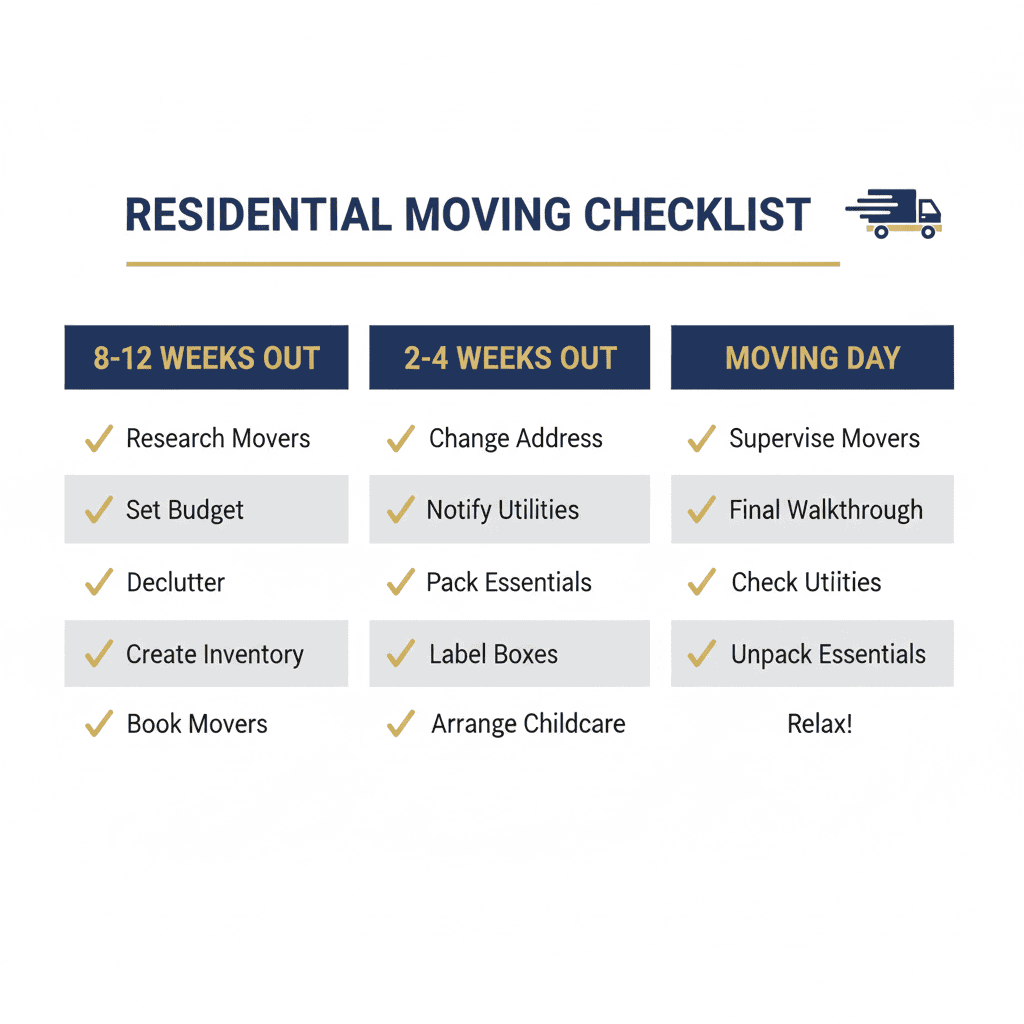
How to Prepare for a Residential Move
The most common mistake Toronto homeowners make: starting too late.
Here’s a practical timeline built for GTA residential moves:
8–12 Weeks Before Moving Day
- Confirm your moving date and book your crew — summer and end-of-month slots in Toronto disappear fast
- Declutter before you pack — donate, sell, or responsibly dispose of items you won’t bring
- Order packing supplies or arrange professional packing services for fragile and high-value items
- Notify your condo building or landlord and reserve elevator access for moving day
- Update your address with Canada Post, CRA, utilities, banks, and subscription services
2–4 Weeks Before Moving Day
- Begin packing non-essential rooms first: guest rooms, storage areas, garage, and basement
- Label every box clearly with contents and the destination room at the new address
- Confirm building access rules — hours, elevator bookings, parking — at both pick-up and delivery addresses
- Arrange childcare or pet care for moving day so nothing is competing for your attention
- Confirm all logistics with your moving company — arrival window, access codes, parking instructions, any special handling requirements
Moving Day Checklist
- Be present or have a trusted contact available at both addresses throughout the move
- Walk through every room before the truck leaves your old address to catch anything left behind
- Photograph high-value items before loading for insurance documentation
- Confirm elevator time holds are in place at the destination building before the truck arrives
- Keep your quote confirmation, insurance documents, and building management contact numbers accessible
How to Prepare for a Commercial Move
Commercial relocations reward early, detailed planning. The more structure you build upfront, the less downtime your business absorbs.
Phase 1 — Business Planning (3–6 Months Out)
- Assign an internal move coordinator who owns all communication between your team and the moving company
- Create a complete inventory: furniture, IT equipment, files, specialty items, and items to be disposed of or donated
- Map the new floor plan and pre-assign workstation destinations so setup is immediate on move day
- Review lease terms and building rules at both the current and new locations — note move-in window restrictions and compliance requirements
- Notify staff, clients, vendors, IT providers, and utilities well in advance of the transition date
Phase 2 — Logistics and IT (4–8 Weeks Out)
- Confirm Certificate of Insurance requirements with both buildings and ensure your moving company provides the correct documentation
- Schedule IT disconnect and reconnect with your provider — this is often the longest lead-time item and cannot be rushed
- Plan for after-hours or weekend move windows to protect business continuity and comply with building access rules
- Arrange temporary storage if there’s a gap between vacating the old space and occupying the new one
- Conduct a joint walkthrough of the new space with your moving coordinator to identify access points, elevator specs, floor protection needs, and any logistical constraints
Phase 3 — The Move Itself
- Execute department by department or floor by floor — phased moves dramatically reduce disruption compared to a single-day big bang
- Have IT staff on-site or on-call during the move for immediate troubleshooting
- Maintain a chain-of-custody log for sensitive files, server equipment, and any regulated materials
- Conduct a same-day punch-list walkthrough at the new location before the crew leaves
- Test all systems — internet connectivity, phones, servers, printers — before your first business day in the new space
Choosing the Right Moving Company for Your Type of Move
Not every moving company in Toronto is equipped for both residential and commercial relocations — and the gap between a qualified and underqualified mover becomes very clear on moving day.
What to Look for in a Residential Mover
- White-glove handling standards: Full wrapping, disassembly, and reassembly included — not as add-ons
- Specialty item experience: Ask specifically about pianos, antiques, and high-value designer furniture
- Transparent, itemized pricing: Hour-based quoting with no surprise fees at the end of the job
- Meaningful insurance coverage: Real protection for your belongings — not just the mover’s minimal liability
- Flexible scheduling: Same-day and last-minute availability for life’s unexpected changes
What to Look for in a Commercial Mover
- After-hours and weekend availability: The default for any serious commercial mover, not an upsell
- COI documentation: Commercial buildings require it — your mover should provide it immediately without pushback
- IT and specialty equipment handling: Certified packing protocols, anti-static crating, and chain-of-custody documentation
- Scope-based project quoting: Pricing that accounts for the full complexity of the move, not just truck and crew
- Verifiable commercial references: Ask specifically for office relocation and multi-floor move experience
Moving GPT: Built for Both — Without Compromise
Moving GPT has been handling residential and commercial relocations across Toronto, Etobicoke, North York, Scarborough, Mississauga, and the wider GTA for over 10 years.
Our service tiers cover the full spectrum:
- Basic and Standard packages — 2–3 movers, equipped truck, essential tools, wrapping, and basic insurance; ideal for apartments, condos, and smaller homes
- Premium and Luxury packages — 4+ movers, full white-glove wrapping, disassembly and reassembly, free consultation, and (at the Luxury tier) post-move cleaning at both locations, furniture arrangement, and a dedicated on-site moving manager
- Commercial moving service — after-hours and weekend scheduling, specialty equipment, COI documentation, IT-safe handling, and phased move planning for businesses of all sizes
Backed by $5,000,000 in moving insurance. Every move. Every client.
Get your free quote at movinggpt.ca or call us at (416) 474-0472.
Frequently Asked Questions
What is the main difference between residential and commercial moving?
Residential moving focuses on personal household items, flexible scheduling, and protecting belongings with white-glove care. Commercial moving prioritizes business continuity — minimizing downtime, coordinating phased relocations, handling IT and specialty equipment, and meeting building-specific regulatory requirements.
How much more does a commercial move cost than a residential move?
Commercial moves typically cost 2–4× more than a comparable-scale residential move. The primary cost drivers are after-hours labour rates, specialty equipment (air bearings, crating, IT handling), longer project timelines, and commercial insurance requirements.
Can one moving company handle both residential and commercial moves?
Yes — but only if they’re genuinely equipped for both. Moving GPT handles residential relocations from studio apartments to luxury homes, and commercial projects from single-office moves to full multi-floor corporate relocations.
How far in advance should I book a commercial move in Toronto?
For most commercial relocations, 3–6 months of planning time is recommended. For a smaller office (under 10 workstations) with a flexible schedule, 4–8 weeks may be sufficient — but earlier is always better.
Do I need special insurance for a commercial move?
Your building will almost certainly require your moving company to provide a Certificate of Insurance (COI) before granting access. Separately, businesses should confirm with their insurer that all assets are covered during transit — commercial liability is typically structured at 3–5% of total asset value.
Does Moving GPT offer same-day commercial moves in Toronto?
We offer same-day and last-minute availability for both residential and commercial moves across the GTA. Call us at (416) 474-0472 to check availability for urgent commercial relocations — we’ll tell you exactly what we can do.
What is a Certificate of Insurance (COI) and why do I need it for a commercial move?
A Certificate of Insurance is a document from your mover’s insurance provider confirming coverage details — limits, policy type, and named parties. Most commercial buildings in Toronto require a COI from the moving company before granting freight elevator access or loading dock permission. Without it, your move can be stopped at the door. Moving GPT provides COI documentation for every commercial job.
How are moving costs calculated for a commercial relocation?
Commercial moves are quoted on full project scope — not just crew and truck hours. Factors include: total number of workstations and specialty items, after-hours or weekend labour rates, IT handling requirements, equipment needs (air bearings, crating), number of floors or buildings, and any phasing to protect business continuity. Moving GPT provides transparent, itemized commercial quotes — no surprises on move day.
Conclusion
Whether you’re relocating a family home or an entire business operation, the decisions you make before moving day determine how the move actually goes.
Residential moves reward early booking, careful preparation, and a mover who treats your belongings with genuine precision and care. Commercial moves demand phased planning, a business continuity mindset, and a partner who understands regulatory requirements, IT logistics, and after-hours execution — not just how to fill a truck.
What to take forward:
- Book residential moves 4–8 weeks out; commercial moves 3–6 months out
- Choose a mover with proven experience in specialty items and commercial-grade equipment
- Confirm COI documentation is in place before any commercial building will grant access
- Never compromise on insurance coverage — Moving GPT protects every move up to $5,000,000
- One company can handle both — when they have 10+ years of experience and the right equipment to back it up
Moving GPT has been Toronto’s trusted relocation specialist for over a decade. Whether it’s a condo move in Liberty Village or a multi-floor corporate relocation across the GTA, we bring the same precision, care, and accountability to every job.
“Professional. Luxury. On Time.” — Get your free quote at movinggpt.ca or call (416) 474-0472).